We are pleased to announce that Dr. Xurong Kong, Kean University, has been selected as the FY 2025 Seminar Program awardee. The seminar moderated by Dr. Xurong Kong will be held soon as follows:
We are pleased to announce that Dr. Baofeng Feng, the University of Texas Rio Grande Valley, has been selected as the FY 2025 Seminar Program awardee. The seminar moderated by Dr. Baofeng Feng will be held soon as follows:
” Mathematics of Turbulence and Shock Waves “ Agenda | Flyer Time: January 26, 2026; 8:30 am – 5:30 pm Venue: Borderlands Room, UTRGV Edinburg Campus, The University of Texas January 27, 2026; 3:00 pm – 4:30 pm Venue: Salon Cassia BMAIN 2.402, UTRGV Brownsville Campus, The University of Texas website: https://sites.google.com/view/utrgvjsps2026/home
The seminar is also available online – see the website for more information.
My reason for visiting Japan in 2019 on a JSPS long-term Fellowship was to collaborate with colleagues on my philosophical research concerning the role of mathematics in science. (See “Philosophy of Mathematics in Nature: Cicadas and Bamboos.”) However, it so happens that I am also an enthusiastic player of shogi, the traditional Japanese version of chess. Spending seven months in Japan allowed me to deepen my experience of shogi in exciting new ways.
I grew up playing chess, and I first discovered shogi when I visited Japan for a conference back in 1996. After that, I started learning shogi, using the few books about the game that had been translated into English. In 2006, I started a shogi club at my home institution, Swarthmore College in Pennsylvania, and this remains the only active college-based shogi club in the USA. In 2008, I won the U.S. Shogi Championship and, as a result, I was invited to participate in the 4th International Shogi Forum, which was held in Tendo City, in Yamagata Province. This triennial event brings together the best amateur shogi players from around the world, and at Tendo I managed to place third in the tournament and win the bronze medal.
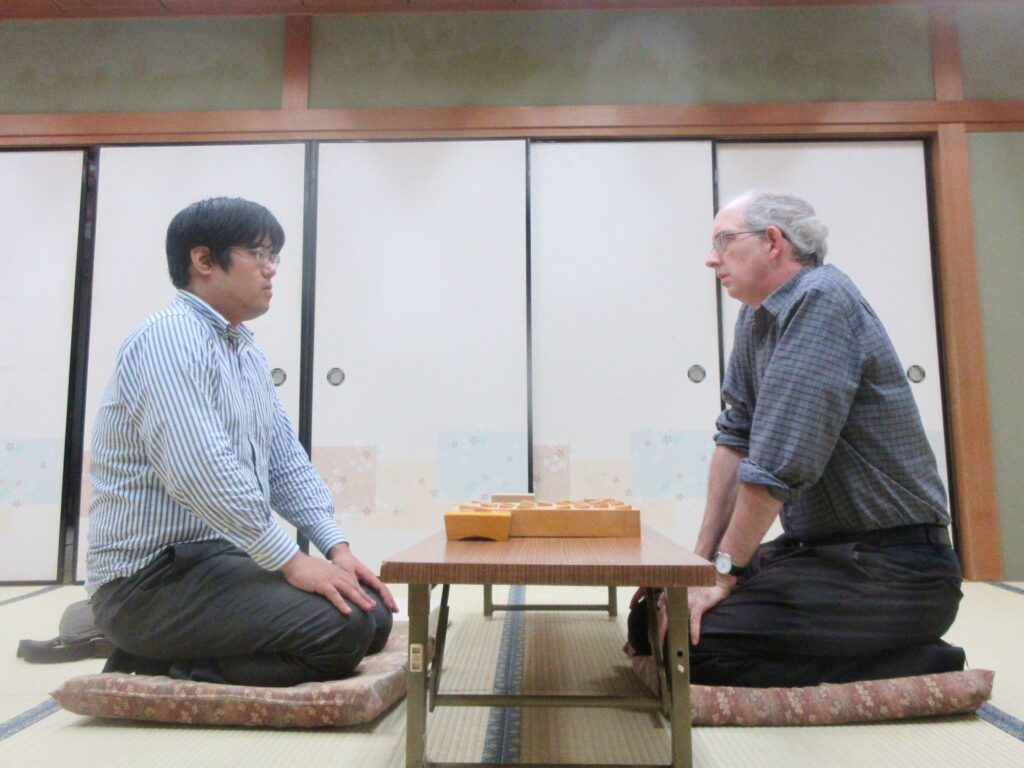
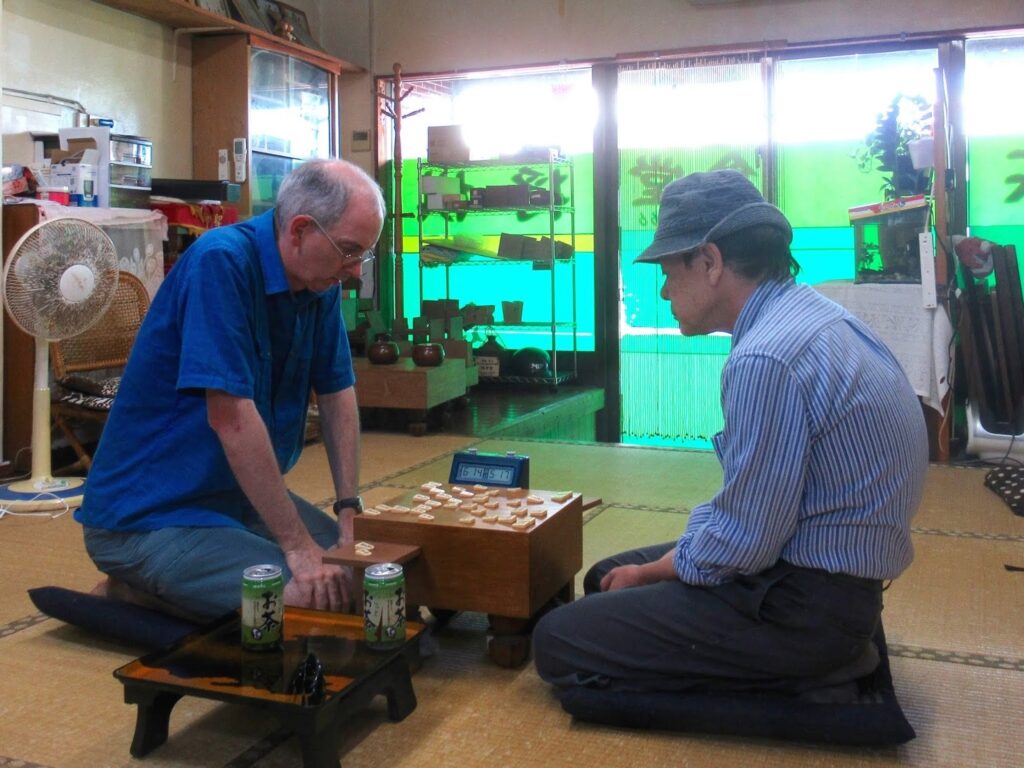
Early on in my 2019 stay in Japan, I visited the Sanjo Shotengai Shogi Club, located in an old-fashioned mall area in central Kyoto. I explained to the club manager that I was a 4-dan shogi player, which corresponds to a strong club player in Japan. However, because Japanese shogi players are not used to foreigners knowing how to play shogi, the club manager seemed to assume that I was talking about my strength at (Western) chess. So he kindly “taught” me the rules of shogi, and then sat me down opposite a 7-year-old boy to try playing a game. Twenty minutes later I had won, so I was paired up next with a man in his 70s who smoked cigarettes and commented on the game as we played. Again I won, and by this time a sizable crowd of spectators had started to gather. My third and final game was against the club manager himself, and this time I really met my match, losing eventually after a hard-fought struggle.
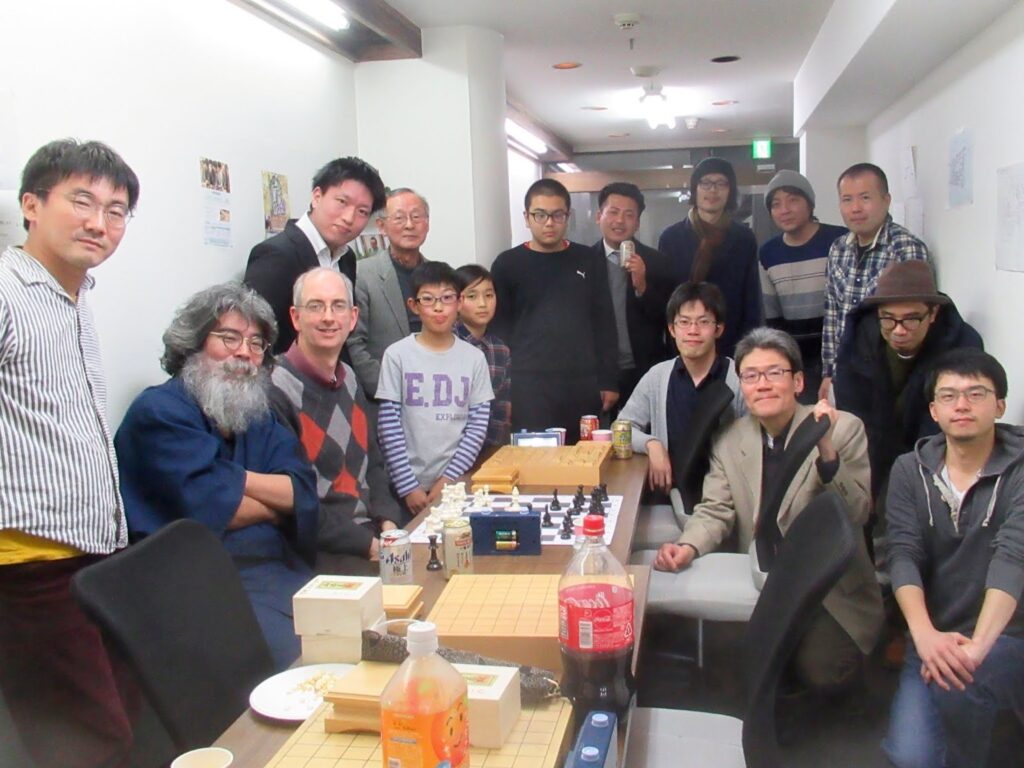
The Sanjo Shotengai Shogi Club ended up becoming my “home” club during my seven months in Kyoto. I even ended up holding a special tournament and party at the club to celebrate my 50th birthday!
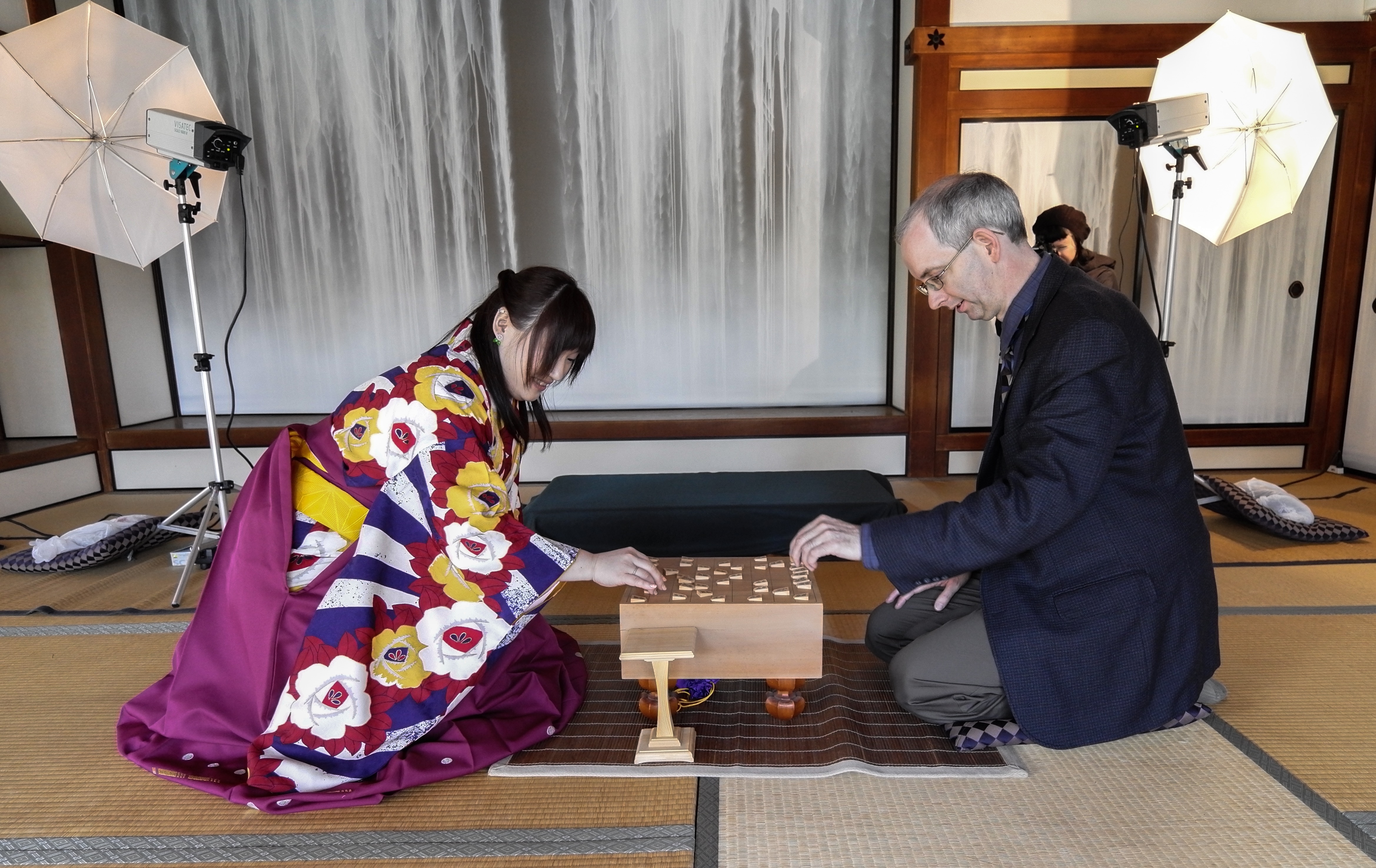
In addition to playing regularly at the local shogi club, I also had the opportunity to play shogi when I traveled to other places in Japan. This included playing at the National Shogi Headquarters in Tokyo, at the Shogi Center in downtown Hiroshima, and at a shogi-themed bar in Osaka. Through a contact at Kyoto University, I also got to meet one of the top professional shogi players, Tetsuro Itodani, a former holder of the prestigious Ryu-O title, and was able to play a handicap game with Itodani at the Kansai Shogi Headquarters in Osaka.
Towards the end of my time in Japan, my family and I visited the island of Ishigaki, towards the southern end of the archipelago of islands that makes up Okinawa Province. I had the opportunity to visit Ishigaki Shogi Club, which is the southernmost shogi club in the whole of Japan. During my afternoon at the shogi club, I had the honor of playing a game against the former amateur shogi champion of Okinawa.
When I returned for a follow-up visit to Japan in summer 2023, I gave a philosophy lecture at Hokkaido University, and while in Hokkaido I traveled up to Wakkanai, in the far north of the island. I visited Wakkanai Shogi Club, which is the northernmost shogi club in Japan, thus completing a nice symmetry from the two geographic endpoints of the country!
In summary, I have found that shogi has provided a unique avenue for me into aspects of Japanese culture that I would not have otherwise been able to discover. Since I do not speak Japanese, it has also allowed me to communicate in another way through playing shogi with new friends. Finally, teaching shogi to students and community members back in America has been a way for me to contribute to spreading a traditional part of Japanese life beyond the borders of Japan.
My reason for visiting Japan in 2019 on a JSPS long-term Fellowship was to collaborate with colleagues on my philosophical research concerning the role of mathematics in science. (See “Philosophy of Mathematics in Nature: Cicadas and Bamboos.”) However, it so happens that I am also an enthusiastic player of shogi, the traditional Japanese version of chess. Spending seven months in Japan allowed me to deepen my experience of shogi in exciting new ways.
I grew up playing chess, and I first discovered shogi when I visited Japan for a conference back in 1996. After that, I started learning shogi, using the few books about the game that had been translated into English. In 2006, I started a shogi club at my home institution, Swarthmore College in Pennsylvania, and this remains the only active college-based shogi club in the USA. In 2008, I won the U.S. Shogi Championship and, as a result, I was invited to participate in the 4th International Shogi Forum, which was held in Tendo City, in Yamagata Province. This triennial event brings together the best amateur shogi players from around the world, and at Tendo I managed to place third in the tournament and win the bronze medal.
Early on in my 2019 stay in Japan, I visited the Sanjo Shotengai Shogi Club, located in an old-fashioned mall area in central Kyoto. I explained to the club manager that I was a 4-dan shogi player, which corresponds to a strong club player in Japan. However, because Japanese shogi players are not used to foreigners knowing how to play shogi, the club manager seemed to assume that I was talking about my strength at (Western) chess. So he kindly “taught” me the rules of shogi, and then sat me down opposite a 7-year-old boy to try playing a game. Twenty minutes later I had won, so I was paired up next with a man in his 70s who smoked cigarettes and commented on the game as we played. Again I won, and by this time a sizable crowd of spectators had started to gather. My third and final game was against the club manager himself, and this time I really met my match, losing eventually after a hard-fought struggle.
The Sanjo Shotengai Shogi Club ended up becoming my “home” club during my seven months in Kyoto. I even ended up holding a special tournament and party at the club to celebrate my 50th birthday!
In addition to playing regularly at the local shogi club, I also had the opportunity to play shogi when I traveled to other places in Japan. This included playing at the National Shogi Headquarters in Tokyo, at the Shogi Center in downtown Hiroshima, and at a shogi-themed bar in Osaka. Through a contact at Kyoto University, I also got to meet one of the top professional shogi players, Tetsuro Itodani, a former holder of the prestigious Ryu-O title, and was able to play a handicap game with Itodani at the Kansai Shogi Headquarters in Osaka.
Towards the end of my time in Japan, my family and I visited the island of Ishigaki, towards the southern end of the archipelago of islands that makes up Okinawa Province. I had the opportunity to visit Ishigaki Shogi Club, which is the southernmost shogi club in the whole of Japan. During my afternoon at the shogi club, I had the honor of playing a game against the former amateur shogi champion of Okinawa.
When I returned for a follow-up visit to Japan in summer 2023, I gave a philosophy lecture at Hokkaido University, and while in Hokkaido I traveled up to Wakkanai, in the far north of the island. I visited Wakkanai Shogi Club, which is the northernmost shogi club in Japan, thus completing a nice symmetry from the two geographic endpoints of the country!
In summary, I have found that shogi has provided a unique avenue for me into aspects of Japanese culture that I would not have otherwise been able to discover. Since I do not speak Japanese, it has also allowed me to communicate in another way through playing shogi with new friends. Finally, teaching shogi to students and community members back in America has been a way for me to contribute to spreading a traditional part of Japanese life beyond the borders of Japan.
The call for applications for BRIDGE Fellowship FY 2026 is now open.
This fellowship program has been carried out as a component of the JSPS’s initiative to build strong networks among researchers in Japan and other countries. The BRIDGE Fellowship will give former fellows of JSPS programs an opportunity to create, sustain and/or strengthen research collaborations with Japanese researchers by revisiting Japan
This program is provided exclusively for the regular members of officially established JSPS alumni associations, including the US and Canada JSPS Alumni Association and who has experienced research in Japan under a JSPS program.
If you have previously participated in a JSPS program but have not yet joined the alumni association, you can become a member by registering on the following page. https://www.jspsusa-alumni.org/membership-information/
We are pleased to announce that Dr. Michael Schramm, Professor of Department of Chemistry and Biochemistry, California State University Long Beach, has been selected as the FY 2025 Seminar Program awardee.
The seminar moderated by Dr. Michael Schramm will be held soon as follows:
Solvent-Alone-Driven Cross-Coupling of Fluorenones for Dibenzo[g,p]chrysene-Based Materials
1st day
Time: September 16, 2025; 4:00 pm – 5:30 pm, PDT
Venue: University California Riverside, Department of Chemistry
2nd day
Time: September 17, 2025; 4:00 pm – 5:25 pm, PDT
Venue: California State University Long Beach, Department of Chemistry and Biochemistry, HSCI Room 103
3rd day
Time: September 19, 2025; 4:00 pm – 5:00 pm, PDT
Venue: San Diego State University, Department of Chemistry and Biochemistry
Short Biography: Prof. Tetsuo Iwasawa was born in Osaka, Japan, receiving his B.S. and M.S. degrees in chemistry from Kyoto University and Ph.D. from Hokkaido University, on the topic of poly-arene ligand synthesis for organometallic chemistry. Between 2005 and 2007 he performed postdoctoral research at the Scripps Research Institute (La Jolla, CA, USA) with Prof. Julius Rebek on the subject of trapping the transient reaction intermediate by a synthetic receptor. Since the spring of 2009 he has been a principal investigator at Ryukoku University (Shiga, Japan), publishing widely in the areas of supramolecular chemistry, reaction development and organic materials. His current focus is on cavitand-driven catalysis and dibenzo[g,p]chrysene-based materials.
All lectures are open to the public.
Please contact Prof. Michael Schramm, michael.schramm@csulb.edu for up-to-date information for campus visitors.
On June 26, the Quebec Chapter held a lively poster session at McGill University, welcoming around 30 researchers and students from universities in the Montréal area, such as Université de Sherbrooke, McGill University, Concordia University, and Université de Montréal. JSPS and JST gave brief introductions to their organizations and programs, followed by a poster session where students presented their research. ( read more )
The call for applications for the US and Canada JSPS Alumni Association Seminar Program FY 2025 is now open.
This program provides opportunities for the members of the US and Canada JSPS Alumni Association to organize a seminar with a researcher from Japan invited to be a speaker.
The program is provided exclusively for the regular members of the Alumni Association and who has experienced research in Japan under a JSPS program.
The call for applications for BRIDGE Fellowship FY 2025 is now open.
This fellowship program has been carried out as a component of the JSPS’s initiative to build strong networks among researchers in Japan and other countries. The BRIDGE Fellowship will give former fellows of JSPS programs an opportunity to create, sustain and/or strengthen research collaborations with Japanese researchers by revisiting Japan.
This program is provided exclusively for the regular members of officially established JSPS alumni associations, including the US and Canada JSPS Alumni Association and who has experienced research in Japan under a JSPS program.
We are pleased to announce that Dr. ZhiQiang Chen, Professor of Civil Engineering, University of Missouri-Kansas City, has been selected as the FY 2024 Seminar Program awardee.
The seminar moderated by Dr. ZhiQiang Chen will be held soon as follows:
Convergence of Physical and Digital Civil Infrastructure: Research Progress and Challenges Agenda | Flyer
Time: September 13, 2024; 9:00 am – 5:00 pm, CTS
Venue: Toyota Room (FH 531), Flarsheim Hall, University of Missouri-Kansas City
Volker Campus, 5000 Holmes St., Kansas City, MO 64110
Workshop website: https://info.umkc.edu/jsps-umkc
The seminar is also available online – see the workshop website for more information.