This was my sixth visit to Japan, but the first time I began to understand the country from inside the daily routine of a Japanese research workplace. On earlier trips, including visits to the STSforum in Kyoto, I came as an international scientist invited to share my perspective on nanoscience and to learn from Japanese colleagues. My JSPS Short-term Invitational Fellowship at the National Institute for Materials Science (NIMS) was different. For a few weeks during winter, I had an office, a laboratory schedule, samples to characterize, meetings to prepare for, and colleagues whose help shaped each day’s activities.
At NIMS, my host, Dr. YAJI Koichiro, and collaborators were focused on a demanding experimental goal: to use advanced photoemission measurements to observe the electronic states of hafnium pentatelluride, a quantum material in which small changes in composition, lattice dynamics, and strain may influence electronic behavior. The scientific purpose of the visit was serious and highly technical. Yet one of the most memorable outcomes of the fellowship was that the science was embedded in ordinary working life: the timing of the shuttle bus, the etiquette of a laboratory, the question of how to meticulously prepare samples, and the generosity of people who helped me understand what I did not yet know.
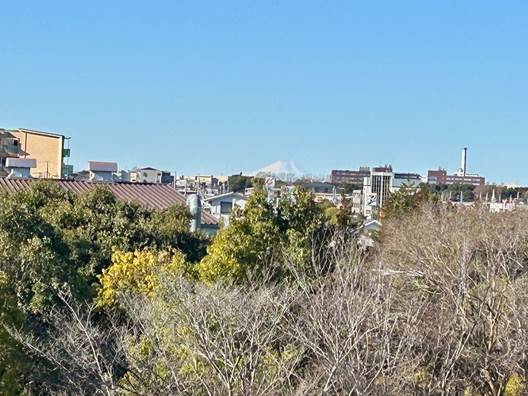
Caption: Mt. Fuji seen from my shared office at the NIMS Sakura site in Tsukuba. During the fellowship, this view served as a reminder of the privilege of working in that setting.
One of the people who helped me see this daily working culture more clearly was a professional staff member supporting the NIMS Photoemission Spectroscopy Group, whose desk was near mine at the Sakura site. She helped me understand how business tasks function in Japan: how requests are handled, how schedules are respected, and how practical details of office life are treated as part of belonging to a research community. She also helped me learn laboratory customs that are difficult to absorb from instructions alone. When a sample-related shipment risked becoming impossible within the time I had available, she kindly drove me so that I could stay on schedule and helped me appreciate different parts of the city. It was a small moment in the logistics of research, but it left a strong impression because it showed how professional courtesy becomes practical support.
She also helped me appreciate the culture of gift-giving in a way that felt personal. I brought a small gift from New Mexico – biscochitos, our official state cookie – and she gave me a tenugui cloth featuring Mt. Fuji as a reminder of my time in our shared office. The exchange was modest, but it carried a meaning I came to appreciate: attention, respect, and recognition that work relationships are also human relationships. She was also the person who taught me how special it was to be able to see Mt. Fuji from our office. I had looked at the mountain as a beautiful view; she helped me understand it as a shared privilege of that place and that clear-sky moment.
This lesson made the JSPS program distinct from a conference or seminar visit. A conference allows me to present ideas. The JSPS fellowship required me to live inside the schedule and responsibilities of a host institution, experiencing a small part of Japanese working life. It showed me how much Japanese scientific research depends on trust, punctuality, preparation, and care for details that are easy to overlook from the outside.
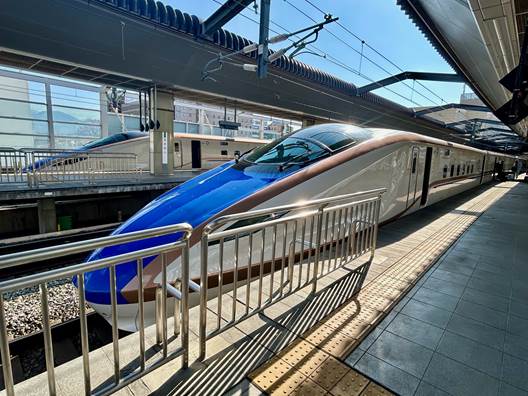
Caption: Hokuriku Shinkansen travel during the fellowship. For this visit, the train was more than a symbol of Japan; it was part of the practical infrastructure that made research exchange possible across institutions.
The Shinkansen became part of that lesson. I had ridden many Japanese trains before, but during the JSPS fellowship the train was not just transportation for a visitor. It was a working tool. It connected discussions at NIMS with seminars and conversations at other institutions, including Shinshu University. On the train, I revised slides, reviewed notes, and thought about how to explain our work to different audiences. The experience made visible how collaboration is not only built in laboratories, but also in the movement between them, in the careful planning that allows a short visit to create durable ties.
One memorable stop was Nagano. During the same trip in which I visited Shinshu University for research exchange, I was able to experience Zenkō-ji. What stayed with me was its contrast with the pace of the fellowship. A day of scientific discussion, seminar preparation, and travel also included a quiet place with a much longer sense of time. Zenkō-ji reminded me that research collaborations occur within societies that have millennia-old histories, customs, and places of reflection. For an international scientist, that context matters. It helps turn a professional trip into a more complete form of exchange.
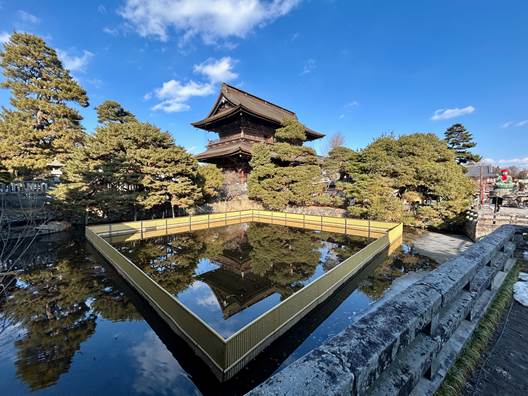
Caption: Zenkō-ji Sanmon in Nagano, visited during the Shinshu University research-exchange portion of the fellowship. The temple offered a quiet counterpoint to the intensive schedule of seminars, travel, and laboratory work.
What I valued most about the JSPS fellowship was that it allowed me to see Japan through the eyes of working Japanese scientists, research staff, and administrative staff, not only through the eyes of a visiting expert. I saw how a laboratory day is organized, how colleagues help each other, and how formal precision and personal kindness can coexist. I also saw that international collaboration is made stronger when people share instruments, solve logistical problems, explain local customs, invite challenging questions, and make space for a visitor to contribute.
The scientific work will continue. The measurements and discussions at NIMS helped define the next stage of our collaboration, including a possible follow-on visit through the JSPS BRIDGE Fellowship. A return visit would allow us to complete more specialized spin-resolved photoemission measurements, strengthen the connection between experiment and theory, and share analysis methods with students and postdoctoral researchers. Those are concrete research goals, but they rest on something equally important: the trust built during my first JSPS-funded visit.
When I think back on this fellowship, I remember the advanced scientific instruments at NIMS and the technical challenge of our experiments. I also remember the view of Mt. Fuji from the office, the speed and calm of the Shinkansen, the quiet presence of Zenkō-ji, and the kindness of many people who helped me understand the everyday customs of work. Together, these experiences gave me a richer view of Japan than I had gained from my previous visits. They showed me that scientific exchange is most meaningful when it is both intellectually serious and personally generous.